This will probably sound familiar: you open your notes app, see hundreds of entries and can't remember why you wrote half of them. Meeting notes, late-night ideas, links to read later, book summaries. And lately, whole conversations with ChatGPT or Claude copied in just in case.
Writing things down gives you a very pleasant sense of progress. The catch is that the feeling arrives when you write, not when you use what you wrote. That's why it's so easy to spend months collecting without anything changing.
Here's a process for making your notes end up helping you decide something.
The note graveyard
That's what we call the place where notes go in and never come back out. It isn't your fault, or your app's: most note systems are built to capture with no effort, and they're very good at it. What almost none of them do is nudge you toward the hard part, which is rereading, comparing and deciding.
Some signs it's happening to you:
- You google something you know you'd already written down.
- You have several notes on the same topic that say different things, and you hadn't noticed.
- You spend more time organizing the system than using it.
- You save whole AI conversations, but can't remember what you concluded.
What a note is missing before it becomes a decision
A note records something: a fact, an idea, a doubt. A decision commits something: time, money or a direction. Getting from one to the other takes work nobody does for you:
- Knowing which question the note answers.
- Knowing what it's worth: whether it's a checked fact or an impression.
- Putting it next to the others to see whether it fits or clashes.
- Deciding which criterion you'll use to choose.
Until a note has been through this, it can't really support a decision.
The process: from capturing to reviewing
There are seven steps. You don't need to do them on the same day, and it's probably better if you don't.
- Capture. Write things down without filtering. Nothing to change here; keep doing it the way you already do.
- Distill. Reduce each note to one sentence that will still make sense in a month. “Meeting with Ana” won't do; “Ana thinks our current price scares off freelancers” will.
- Connect. Ask which pending decision that sentence helps with. If none, it can stay archived with a clear conscience.
- Compare. Put it next to the other sentences for that decision. Does it support them or contradict them? Is it a fact or an assumption?
- Decide. With everything in front of you, choose using a criterion you can explain.
- Record. Write the decision down along with why (there's a template below).
- Review. Give it a date or a condition for looking at it again.
Keep possibilities, not to-dos
Going through notes brings up good ideas that don't belong to now: another project, an improvement for later, an interesting but secondary question. It's tempting to turn them into tasks, and every new task is one more small weight.
There's another option, which is keeping them as possibilities. A possibility has no date and no reminder, doesn't show up on today's list and asks nothing of you. It's just there, with its context, for whenever you feel like coming back.
You notice the difference most when you stop for the day. Thirty pending tasks weigh on you; thirty saved possibilities are more like a place to come back to whenever you want.
A template for recording a decision
Copy it and use it as is. It works on paper, in any notes app or in a shared document.
The field that usually turns out most useful is “what would make you revisit it”. When doubts creep in three months from now, you won't have to start from scratch: you'll just need to check whether that has happened.
What good software should do for you
If you're going to use a tool for this process, ideally it does the heavy lifting without taking the decision away from you. Specifically, it should:
- Read all your material, not just the latest note, including AI conversations you paste in as they are.
- Warn you about contradictions and gaps, telling you exactly which notes clash.
- Always cite where it gets each thing, because a conclusion without a source is just another opinion.
- Suggest things, but not change your work without your permission.
- Let you try alternatives without spoiling what you already have.
- Speak up when it has something to add, not every time you type.
How Noemori does it
With Noemori you can bring your material as it is: notes, documents or conversations pasted from ChatGPT or Claude. If it isn't known who said something in a conversation, it stays unknown; nothing gets made up. The living layer, which is Noemori's AI, places each piece on your idea's map and shows you what it supports or calls into question, always citing your notes.
You can debate any piece: the living layer argues the other side or runs a pre-mortem (imagining it went wrong and looking for why), and whatever holds up stays in your record. Ideas that don't belong to today go into “Possibilities for later”, off the map and with no reminders. When the time comes, it drafts a decision memo, a project brief or an experiment plan with every claim linked to the piece it comes from. And when you finish, “Enough for today” notes what changed, what's still open and what you kept for later.
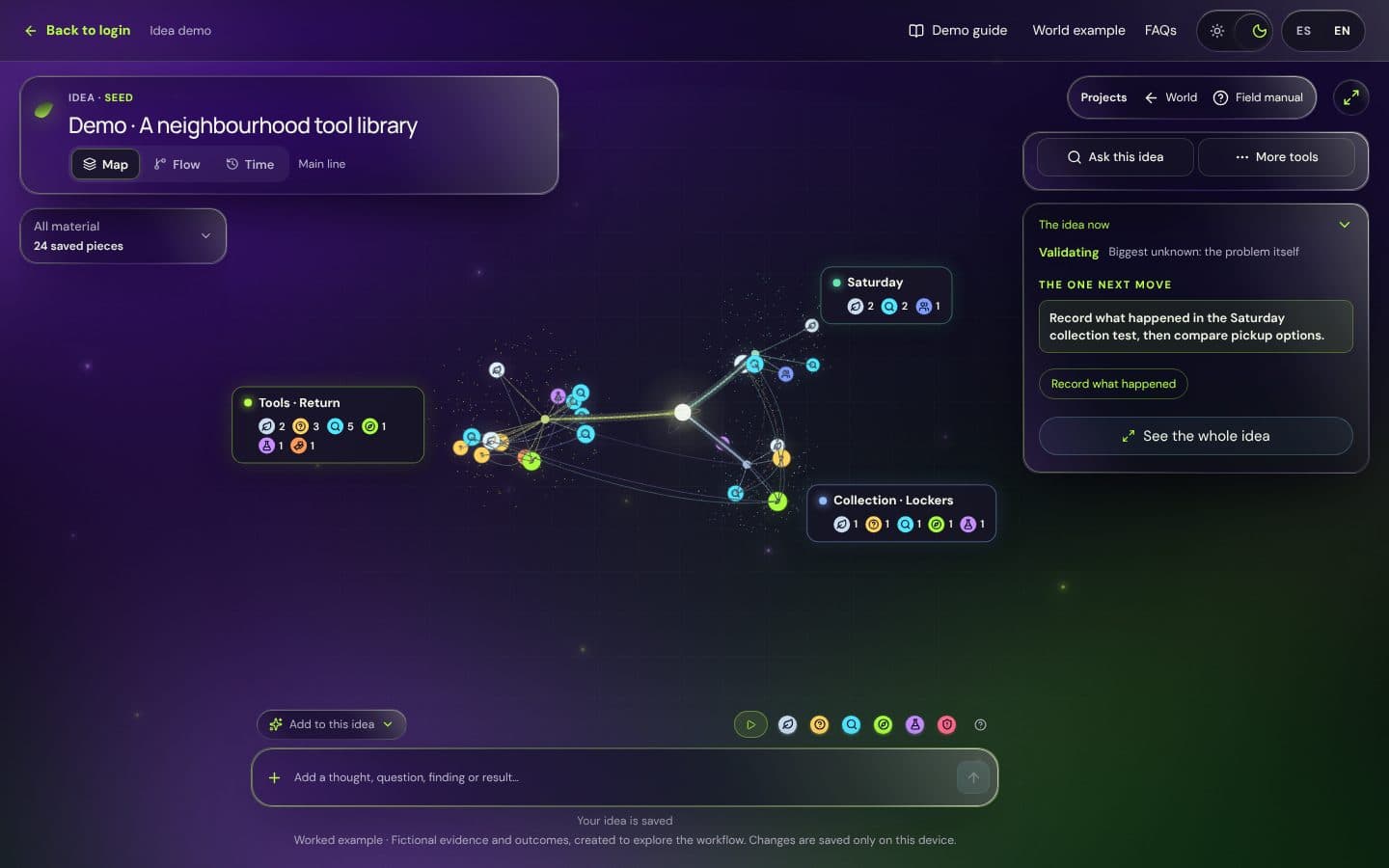
If you'd like to see a complete example, open the example idea with no account, and if yours is a business idea starting from scratch, carry on with the step-by-step guide. To use it with your own notes, the pilot is free: ask for your place below.
Frequently asked questions
What software can turn notes into decisions?
If you follow the process, almost any tool will do, even paper. What good software adds is reading all your material at once, warning you about contradictions with the notes cited, and keeping the reason behind each decision. Check for those three things before switching tools.
Do I have to delete my old notes to start?
No. Start with a single pending decision and distill only the notes related to it. The rest can stay where it is.
How do I use my ChatGPT or Claude conversations as notes?
Paste them in, but distill them like any other note: keep the useful sentences and mark each one as a fact, an assumption or a question. What a language model suggests is a starting point, not proof of anything.
How often should I review my decisions?
When the condition you wrote under “what would make you revisit it” is met. If you didn't set one, going over important decisions every few months is usually enough.