Lots of business ideas go one of two ways. Either they spend months going round in your head without ever meeting reality, or they jump straight to a website, a logo and an Instagram account before anyone has said they need them.
This guide covers the bit in between, which is exactly the part people rarely talk about: how to get from a hunch to a first experiment that actually tells you something. We won't talk about registering a company or raising money. We'll talk about knowing what to test, why, and what you'll do with whatever comes out of it.
If you follow it to the end, you'll have a well-framed question, your assumptions written down, an experiment thought through and a one-page summary you can show to anyone.
How to use this guide
You don't need to do it all at once, and I'd suggest you don't. Each step is meant for one short working session, the kind that fits into an evening or before dinner. At the end of each one there's a box with the least you need to do that day, what's worth parking, and a sentence to close with so you know where to pick up next time.
We set it up this way because a lot of ideas aren't dropped for lack of method. They're dropped out of tiredness: too many fronts open, none of them moving, until one day you stop opening the document. Going slowly, but knowing where you're heading, tends to get a lot further.
Step 1: Write the idea as a problem, not a solution
“I want to start a bread subscription” already has the answer built in. And if that answer turns out to be wrong, the question underneath usually goes in the bin with it, even though it might have been a good one.
Try rewriting it with this formula:
[Who] struggles to [what] when [in what situation].
For Maya it would read something like: “Working families in the neighborhood can't get here before the good bread runs out, especially early in the week”.
Written like that, other ways out show up that you couldn't see before: reserving bread, opening later, a locker, home delivery. The subscription is still an option, but no longer the only one, which gives you room if it doesn't work. It's probably the cheapest thing you can do to avoid heading down the wrong road.
Step 2: Make your assumptions visible
Behind any idea there are things you take for granted without having checked them. While they're only in your head they feel like facts; once you write them down, it's obvious they're bets.
To get them out, it helps to ask yourself:
- Do people really have this problem? Does it bother them enough to change what they do?
- Will someone pay enough to make it worth your while?
- Do you have the time and the means to do it well?
Maya writes these down:
- Families would pay for a monthly subscription upfront.
- What they want is bread delivered, not a trip to the shop.
- The margin covers delivery.
- She can bake 30% more on Mondays without hiring anyone.
A trick that works: write each assumption so that it could turn out to be false. “People like artisan bread” can't be checked. “They'd pay $25 a month upfront” can.
Many of the expensive mistakes in small projects come from an assumption nobody stopped to write down.
Step 3: Find the assumption that could sink you
They don't all weigh the same. Rank them by two things: how much damage it would do if it were false, and how much evidence you have that it's true. The one that would do the most damage with the least evidence goes first. The rest can wait.
When two of your notes contradict each other, it's worth stopping. Quite often that's where the most important thing you don't know yet is hiding. That's why it helps to have someone nearby (a partner, a friend, a method, a tool) who points it out instead of agreeing with you.
Step 4: Talk to real people, and ask about facts
This is where most ideas fool themselves. You ask “would you sign up for a bread subscription?” and nearly everyone says yes, to be nice or because imagining the future costs nothing.
Rob Fitzpatrick has a short, very readable book on this, The Mom Test, about talking to potential customers without them lying to you (even unintentionally). His rules boil down to three:
- Talk about their life, not your idea. As soon as you pitch, people start giving opinions on your idea and stop telling you what happens to them.
- Ask about what they did, not what they would do. We're pretty bad at guessing what we'll do and pretty good at remembering what we did.
- Talk little and listen a lot.
Maya's questions change like this:
| Instead of… | Ask… |
|---|---|
| Would you subscribe to weekly bread? | When was the last time you couldn't get good bread? What did you do? |
| Do you like the idea of delivery? | How do you do your Monday shopping now? |
| How much would you pay? | Do you already pay for anything upfront every month? What? |
There's no magic number of conversations, but after five to eight good ones things start repeating. Write down each interesting answer separately, as it was said: “Marta buys supermarket bread on Mondays because she finishes work late” will be far more useful than a summary like “people value convenience”.
Step 5: Design the cheapest possible experiment
An experiment isn't a small launch of your business. It's the cheapest way to check the assumption that worries you. Before you start, write down three things: what you'll do, what you expect to happen and what result would change your mind.
The last one is the one people forget, and it's the most important. If you don't write it down beforehand, any result will look like a good sign.
There are cheap experiments of all kinds:
- A pre-sale, where you ask for payment or a commitment before the product exists.
- Doing it by hand, with no system or website, handling everything yourself.
- A simple page describing the offer, to see how many people sign up.
- A paper prototype: you show a sketch and watch what the person does with it, not what they say.
And you don't need to risk what already works. Maya doesn't change anything in her bakery; she tries the new thing alongside it, without rushing.
Step 6: Write down what happens, including what you don't like
When the result comes in, the easy thing is to keep what confirms what you already thought. Try not to. What makes you uncomfortable is what teaches you most, precisely because you didn't expect it.
For each result, note which assumption it answers and whether it strengthens or weakens it. A month from now you'll be glad to know why you decided what you decided.
Step 7: Decide whether to continue, change course or let the idea rest
With what you've learned in front of you, you have three sensible options:
- Carry on, if the assumption holds, and move to the next most dangerous one.
- Change approach, if the problem is real but the solution was a different one.
- Let it rest, if right now you don't have the time, the money or the energy.
Maya changes approach: she'll try setting bread aside and puts the subscription to rest. She doesn't throw it away; she might pick it up again when she has more customers.
Parking an idea is fine, as long as you write down where you left it. What really hurts is coming back six months later without remembering why you stopped or what was missing.
Write the decision down with the criterion you used and what would make you reconsider it. If it helps, the article on how to turn your notes into decisions has a template you can copy.
Step 8: Ask for specific help
Very few ideas get off the ground without anyone's help. But “I need help with my business” doesn't work, because the other person has no idea where to start. Compare it with “I need half an hour with someone who has worked out what bike delivery costs across a neighborhood”.
A request that works says what you need, which decision you need it for and how much of the other person's time you're asking for.
And when someone helps you, tell them, and write down what changed thanks to them. It's good manners, of course, but it also makes it easier for you to ask next time, and for them to offer.
Step 9: Sum it up on one page
The last step is pulling everything together into something anyone can read in two minutes: your business partner, the bank, a friend who knows the field, or you, six months from now.
How to stop without losing the thread
Getting an idea off the ground takes time and comes with a lot of pauses. And the way you stop matters almost as much as the way you move forward.
There's a study I find really useful here. In 2011, psychologists E. J. Masicampo and Roy Baumeister looked at what happens to the goals we leave half-done. They found these goals keep hanging around in your head and creep in when you try to do something else. But they also found the effect went away once people wrote a specific plan for picking them up. Finishing the task wasn't necessary; knowing when and how you'd carry on was enough.
In practice, that comes down to three simple habits:
- Before you start, decide what would be enough to get done that day.
- Whatever occurs to you that doesn't belong to today, note it somewhere else, with no date or reminder.
- When you finish, write two or three lines on what changed, what's still pending and where you'll pick up.
It's also worth looking at the tools you use. If every time you open your work you're greeted by a list of notifications, suggestions and pending tasks, it's easy to end up working for the tool. I go into this in more detail in the article on digital wellbeing in creative work.
The most common mistakes
- Falling for the solution before understanding the problem.
- Asking for opinions instead of asking about facts, and mistaking politeness for real interest.
- Running an experiment without deciding beforehand which result would change your mind.
- Having ten ideas open at once, with none of them moving.
- Never stopping, or quitting without noting where you'd got to.
How Noemori does it
We built Noemori to work exactly this way, so here's how it fits with what you've just read.
You start with a question instead of a blank page. Every note, conversation or document you add becomes a piece, and the living layer (Noemori's AI) places it on your idea's map, next to what it supports or calls into question. If two pieces clash, like Maya's convenience and her counter, it tells you, citing your own notes, and you decide whether it's right. Nothing changes until you accept it.
For your working rhythm there's the “This session” panel. There you can note what would be enough today, set the living layer to Quiet so it doesn't propose anything on its own, keep possibilities for later (they take no space on the map and never remind you of anything) and close with “Enough for today”, which saves what changed and leaves you a clear place to come back to.
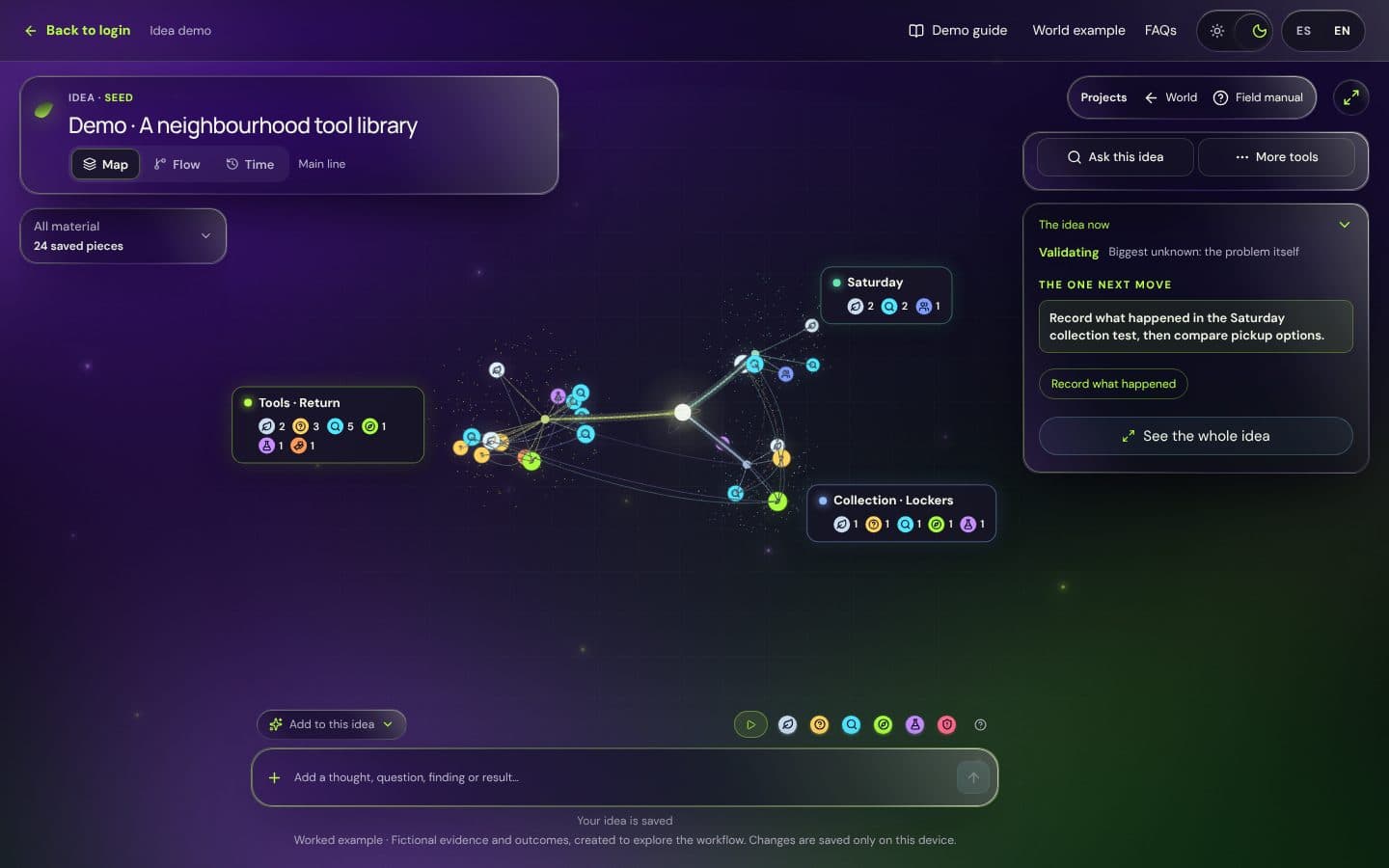
The rest is there too: TEST lines to explore another direction without touching the main one, needs you can publish to ask for specific help without showing your workspace (and help that changes your idea is credited to whoever gave it), ideas that can rest without losing their history, and documents such as the brief, the experiment plan or the decision memo, drafted from your own work with every claim cited.
You can try it in the example idea with no account. And if you'd like to use it with an idea of your own, the pilot is free: ask for your place below.
Frequently asked questions
How long does it take to validate a business idea?
It depends on which assumption you want to check, not on the whole idea. A well-chosen first experiment can give you a useful signal in a week or two. Validating the whole business takes months and quite a few experiments in a row.
Do I need money to start testing my idea?
For the first experiment, hardly ever. Talking to people, a simple pre-sale or delivering the service by hand mostly costs time. If your first step needs a big investment, you're most likely testing the solution before the problem.
What if nobody wants to talk to me?
Ask for less and be more specific: ten minutes to tell you about something they went through, not half an hour to give opinions on your idea. Start with people one or two steps away from your circle and, at the end, ask who else you could talk to.
Can I use ChatGPT to develop my business idea?
Yes, and it's handy for finding assumptions you've missed, preparing questions or spotting contradictions in your notes. What it can't do is replace conversations with real people, because it doesn't know what your customers did last week.
When should I give up on an idea?
When what you've learned contradicts the assumption everything depends on, and you can't see another way to solve the problem. Even then, it's often better to let it rest with a good summary than to throw it away. Circumstances change, and what you learned isn't lost.